Are My Medical Exams Correct?

Angelica Rice • May 4, 2023

      As part of the Form I-485, Adjustment of Status application process, or the Immigrant Visa process if the Applicant is applying from abroad, USCIS requires that all Applicants be properly vaccinated and have a properly filled out Form I-693, Medical Examination form prepared by a USCIS authorized Civil Surgeon or Panel Physician and submitted to USCIS in a sealed envelope. 


      Unfortunately, many Applicants and immigration Practioners often run into situations where the authorized surgeon or physician has not properly completed the medical exam and it has led to detrimental consequences for their Adjustment process, including denial of their Form I-485 application or Immigrant Visa application. 


      First, the Civil Surgeon or Panel Physician should provide the Applicant with a copy of the medical examination results that are being sealed and provided to USCIS. This way the Applicant and/or their immigration attorney can view and check the results before sending the sealed envelope to USCIS. This will prevent erroneously completed medicals from being sent to USCIS and will reduce the chances that their Form I-485 is denied or otherwise negatively impacted by a deficient medical exam.


      Second, the Applicant or their immigration attorney (if they have one), should review the copy of the medical exam they are given and make sure that they are completed in accordance with the USCIS and CDC vaccination requirements. These requirements can be found on the following websites:


https://www.uscis.gov/tools/designated-civil-surgeons/vaccination-requirements

https://www.cdc.gov/immigrantrefugeehealth/civil-surgeons/vaccinations.html


The Immigration and Nationality Act (INA)¹ specifies the following vaccinations must be administered or completed as part of the medical exam:


  • Mumps, measles, rubella;
  • Polio;
  • Tetanus and diphtheria toxoids;²
  • Pertussis;
  • Haemophilius influenza type B; and
  • Hepatitis B.
  • CDC requires the following additional vaccines for immigration purposes:
  • Varicella;
  • Influenza;
  • Pneumococcal pneumonia;
  • Rotavirus;
  • Hepatitis A;
  • Meningococcal; and
  • COVID-19.


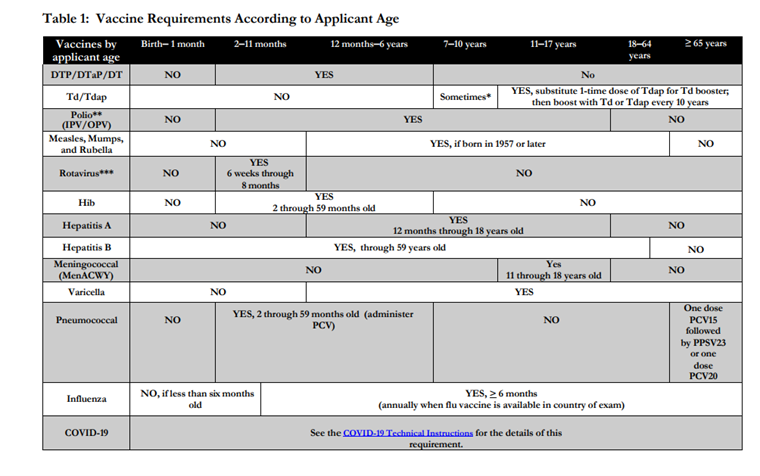
      If the applicant has not received any of the listed vaccinations and the vaccinations are age appropriate and medically appropriate, the applicant has a Class A condition and is inadmissible. Generally, all age-appropriate vaccine rows of the vaccination assessment must have at least one entry before the assessment can be considered to have been properly completed. However, the COVID-19 vaccination (required as of October 1, 2021) differs in that the applicant must complete the entire vaccine series (one or two doses depending on formulation).³


      In order to determine which vaccines are “age appropriate” the Civil Surgeon or Panel Physician, should be referencing the vaccine requirements chart contained in the CDC Vaccination Technical Instructions. See this chart below⁴:

      If you have questions about USCIS required medical examinations or if your Form

I-693 was properly completed, please contact our office for assistance today! 


¹ See INA 212(a)(1)(A)(ii).

² Applicants who have completed the initial DTP/DTaP/DT or Td/Tdap series should receive a Td/Tdap booster shot every 10 years. If the last dose was received more than 10 years ago, the applicant is required to have the booster shot, otherwise the applicant is inadmissible under INA 212(a)(1)(A)(ii).

³ For more information, including current dosage requirements for the immigration medical examination, see the CDC Requirements for Immigrant Medical Examinations: COVID-19 Technical Instructions for Civil Surgeons webpage.

https://www.cdc.gov/immigrantrefugeehealth/civil-surgeons/vaccinations.html


This blog is not intended to be legal advice and nothing here should be construed as establishing an attorney client relationship. Please schedule a consultation with an immigration attorney before acting on any information read here.


This Facebook widget is no longer supported.

Angelica Rice

By Juliana LaMendola September 22, 2026
On September 14, 2026, the U.S. District Court for the District of Massachusetts issued a nationwide preliminary injunction in Presidents' Alliance on Higher Education and Immigration v. U.S. Department of Homeland Security , halting the implementation of the Department of Homeland Security (DHS) final rule that was scheduled to eliminate “duration of status” (D/S) on September 15, 2026. As a result of this nationwide order, DHS is blocked from enforcing fixed periods of admission for F-1 students, J-1 exchange visitors, and I media representatives while the litigation moves forward. Because the current “duration of status” framework remains in full effect, F, J, and I visa holders are not required to file Form I-539 extension of stay applications to remain in valid status beyond program end dates at this time. Furthermore, restrictions on academic transfers, constraints on enrolling in second programs at the same degree level, 240-day caps on continued employment while extensions are pending, and shortened grace periods do not apply during the injunction. F-1 nonimmigrants retain the full 60-day post-completion grace period, and J-1 holders maintain their 30-day grace period. However, please note that this preliminary injunction is not a final ruling invalidating the rule , and a status conference is scheduled for October 2, 2026, to determine next steps in the litigation. Immediate Practice Tips: Inspect I-94 Travel Records Upon Reentry: F, J, and I visa holders currently admitted under D/S retain their status and should continue to be readmitted under D/S following international travel until the injunction is lifted. However, because the I-94 record controls legal stay, travelers must inspect their CBP-issued Form I-94 immediately upon reentry to confirm the "Admit Until Date" states "D/S" rather than a specific expiration date. If a specific date is mistakenly recorded, contact a local CPB Deferred Inspection Site. Notify HR and Review Workplace Compliance: Employers sponsoring F-1 or J-1 employees should inform HR and hiring managers that the September 15 fixed-period rule is postponed and standard D/S rules govern. This development does not alter standard filing windows or Form I-9 verification procedures for post-completion OPT or STEM OPT extensions.  Maintain Operational Readiness and Defer Unnecessary Filings: Visa holders and employers should defer travel or filing strategy decisions made solely in anticipation of the fixed-admission rule. Because DHS may appeal or the court could alter the timeline on short notice, institutions and visa holders should maintain readiness to adjust plans if implementation resumes. There are many evolving components to this litigation. If you are an F-1, J-1, or I visa holder, sponsoring institution, or employer, you should proactively coordinate with your international student office and legal counsel to protect your status and monitor upcoming court proceedings.
By Juliana LaMendola September 3, 2026
The Department of Homeland Security (DHS) published its final rule eliminating the longstanding "duration of status" (D/S) policy for F, J, and I visa holders, replacing it with a fixed period of admission effective September 15, 2026. This rule requires that those who need additional time to complete their programs must file Form I-539 with USCIS or travel abroad and seek to reenter to extend their authorized period of stay. F and J visa holders present in the U.S. and in valid status on September 15, 2026, will be allowed to remain in the United States until the Program End Date listed on their current Form I-20 (for F-1s) or Form DS-2019 (for J-1s), up to a maximum of four years (until September 15, 2030) plus a 60-day grace period for F-1s and a 30-day grace period for J-1s, without filing an Extension of Status request with USCIS. However, this safety net only applies while staying in the U.S.; international travel and subsequent reentry after September 15, 2026 will result in readmission under the new rule with an I-94 that expires on the Program End Date or Employment Authorization Document (EAD) expiration, but no later than four-years after their date of re-entry. Additionally, once re-admitted under the new rules, F-1s will only receive a 30-day grace period. Immediate Practice Tips: Any F-1 or J-1 nonimmigrant currently in the U.S. who plans to change programs, start a new degree level, or needs more time to complete their studies must work with their school or program sponsor to update their SEVIS record and receive an extended Form I-20 or DS-2019 before September 15, 2026. Eligible F-1 students should submit their post-completion OPT or STEM OPT work authorization applications (Form I-765) before September 15, 2026, to secure their status and drastically reduce the likelihood of needing a Form I-539 extension application. Any F-1 student who is eligible to apply for OPT or STEM OPT before March 18, 2027, should do so as soon as they are eligible to file their Form I-765. Since F-1s can file OPT applications up to 90 days in advance of graduation, F-1 students graduating before June 15,2027, should be able to file their OPT applications before March 18, 2027, and should do so to avoid also having to file Form I-539 to extend their stay. Thus, most F-1 students graduating in December 2026 and May/June 2027 should be able to take advantage of the transition rule’s delay in having to file Form I-539 applications and should only need to file Form I-765 to apply for OPT. Incoming F-1 and J-1 students who can enter the United States before the September 15, 2026 effective date (within the permissible 30-day window prior to their program start) should do so to benefit from the transition rules, including the full 60-day F-1 grace period and deferred extension requirements. Students (F-1 and J-1) who are planning international travel should return before the effective date if possible to preserve their transition benefits.  There are many parts of the rule that are not discussed here. If you are currently an F-1 or J-1 visa holder, you should proactively coordinate with your institutions and international office to protect your status and stay informed.
By Kris Quadros-Ragar August 27, 2026
U.S. Citizenship and Immigration Services (USCIS) has released updated policy guidance detailing how officers will evaluate "public charge" inadmissibility for individuals applying for green cards through adjustment of status. This update follows a Department of Homeland Security (DHS) final rule that rescinds the 2022 public charge regulations. The new policy takes effect on September 18, 2026 , and applies to all green card applications (Form I-485) postmarked or submitted on or after that date. Who Is Subject to the Public Charge Rule? Most family-based and employment-based green card applicants will be subject to the public charge ground of inadmissibility. This includes spouses, children, and parents of U.S. citizens or legal permanent residents, as well as most employment visa preference categories, investors, and diversity visa applicants. Certain categories remain explicitly exempt under immigration law. These include: Asylees and refugees Victims of human trafficking (T visa) or crime (U visa) Violence Against Women Act (VAWA) self-petitioners Special Immigrant Juveniles Temporary Protected Status (TPS) applicants Certain military-related applicants and other designated humanitarian groups How USCIS Will Make Determinations USCIS officers will evaluate whether an applicant is likely to become a public charge by reviewing the totality of their circumstances on a case-by-case basis. Key factors include: Five Statutory Factors: Age, health, family status, assets/financial resources, and education or skills. Affidavit of Support: Submission of Form I-864 executed by a sponsor. Use of Public Benefits: USCIS will look at means-tested public benefits, such as cash assistance for income maintenance, housing assistance, food stamps (SNAP), or college financial aid. Note on timing: For benefits received before September 18, 2026, USCIS will only consider public cash assistance for income maintenance and long-term institutionalization at government expense. For benefits received on or after September 18, 2026, the broader consideration of all listed means-tested benefits will apply. Public Charge Bonds If an officer determines that an applicant is inadmissible solely on public charge grounds, USCIS may issue a Notice of Intent to Deny that invites the applicant to post a public charge bond using Form I-945. If an invited applicant successfully posts the required cash or surety bond, USCIS may approve the application for permanent residence. Public charge bonds can only be submitted if explicitly invited by USCIS. Santos Lloyd Law Firm will continue to monitor immigration developments closely and provide updates as further implementation details are released. For more information, please access: https://www.uscis.gov/newsroom/alerts/uscis-issues-guidance-on-making-public-charge-inadmissibility-determination
Show More