
Os Meus Exames Médicos Estão Corretos?

Angelica Rice • November 16, 2023

Click here to read this article in English

      Como parte do processo de aplicação do Formulário I-485, Ajuste de Status, ou do processo de Visto de Imigrante, se o requerente estiver aplicando do exterior, a USCIS exige que todos os requerentes estejam devidamente vacinados e tenham o Formulário I-693 devidamente preenchido, que é o formulário de Exame Médico preparado por um Cirurgião Civil ou Médicos cadastrados e autorizados pela USCIS, e enviado a USCIS em um envelope lacrado.


       Infelizmente, muitos requerentes e profissionais de imigração frequentemente se deparam com situações em que o cirurgião ou médico autorizado não completou adequadamente o exame médico, o que resultou em consequências prejudiciais para o processo de ajuste deles, incluindo a negação do Formulário I-485 ou do pedido de Visto de Imigrante.


      Primeiramente, o Cirurgião Civil ou Médico cadastrado deve fornecer ao requerente uma cópia dos resultados do exame médico que está sendo lacrado e enviado a USCIS. Dessa forma, o requerente e/ou seu advogado de imigração podem visualizar e verificar os resultados antes de enviar o envelope lacrado a USCIS. Isso evitará que exames médicos erroneamente preenchidos sejam enviados a USCIS e reduzirá as chances de que o Formulário I-485 seja negado ou afetado negativamente por um exame médico deficiente.


       Em segundo lugar, o requerente ou seu advogado de imigração (se tiver um) deve revisar a cópia do exame médico que lhes é fornecida e garantir que esteja preenchida de acordo com os requisitos de vacinação da USCIS e CDC. Esses requisitos podem ser encontrados nos seguintes sites:


https://www.uscis.gov/tools/designated-civil-surgeons/vaccination-requirements

https://www.cdc.gov/immigrantrefugeehealth/civil-surgeons/vaccinations.html


A Lei de Imigração e Nacionalidade (INA)¹ especifica que as seguintes vacinas devem ser administradas ou concluídas como parte do exame médico:


  • Caxumba, sarampo, rubéola;
  • Poliomielite;
  • Tétano e toxoides diftéricos;²
  • Coqueluche;
  • Haemophilus influenza tipo B; e
  • Hepatite B.
  • Os CDC exigem as seguintes vacinas adicionais para fins de imigração:
  • Varicela;
  • Gripe;
  • Pneumonia pneumocócica;
  • Rotavírus;
  • Hepatite A;
  • Meningococo; e
  • COVID-19.


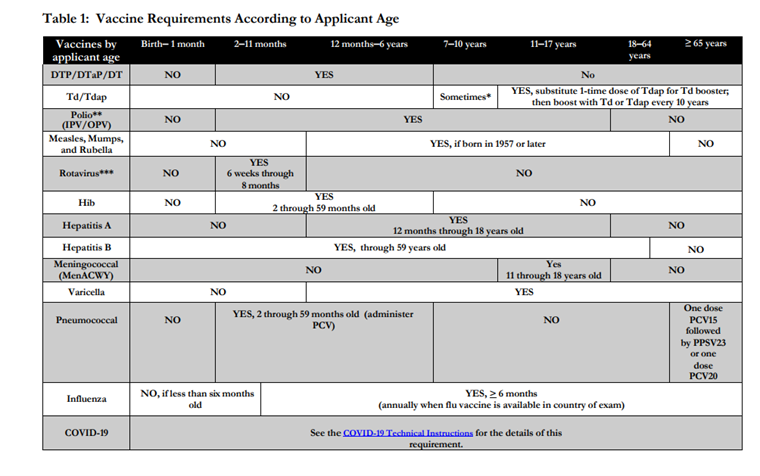
      Se o requerente não tiver recebido nenhuma das vacinas listadas e as vacinas forem apropriadas para sua idade e clinicamente adequadas, o requerente tem uma condição de Classe A e é inadmissível. Geralmente, todas as linhas de vacinas apropriadas para a idade na avaliação de vacinação devem ter pelo menos uma dose antes que a avaliação possa ser considerada como devidamente concluída. No entanto, a vacinação contra a COVID-19 (obrigatória a partir de 1º de outubro de 2021) difere, pois o requerente deve concluir toda a série de vacinas (uma ou duas doses, dependendo da formulação).³


       Para determinar quais vacinas são "apropriadas para a idade", o Cirurgião Civil ou Médico cadastrado deve consultar o gráfico de requisitos de vacinação contido nas Instruções Técnicas de Vacinação dos CDC. Veja este gráfico abaixo⁴:

     Se você tiver dúvidas sobre os exames médicos exigidos pela USCIS ou se o seu Formulário I-693 foi preenchido corretamente, por favor, entre em contato com nosso escritório para obter assistência hoje mesmo!


¹ Veja INA 212(a)(1)(A)(ii).

² Os requerentes que tiverem concluído a série inicial de DTP/DTaP/DT ou Td/Tdap devem receber uma dose de reforço de Td/Tdap a cada 10 anos. Se a última dose tiver sido recebida há mais de 10 anos, o candidato deverá tomar a vacina de reforço; caso contrário, ele será inadmissível de acordo com a INA 212(a)(1)(A)(ii).

³ Para obter mais informações, incluindo os requisitos atuais de dosagem para o exame médico de imigração, consulte a página da Web  :CDC Requirements for Immigrant Medical Examinations: COVID-19 Technical Instructions for Civil Surgeons 

https://www.cdc.gov/immigrantrefugeehealth/civil-surgeons/vaccinations.html


Este blog não se destina a fornecer aconselhamento jurídico e nada aqui deve ser interpretado como estabelecimento de um relacionamento advogado-cliente. Por favor, agende uma consulta com um advogado de imigração antes de agir com base em qualquer informação lida aqui.

This Facebook widget is no longer supported.

Angelica Rice

By Joseph Lennarz April 23, 2026
Choosing the right recommenders is one of the most critical steps in building a successful O-1 visa petition. The standard for this visa is a high one, you must not only be an accomplished professional within your field but among the very top cadre of your peers. Reference letters serve as the connective tissue of an O-1 petition, transforming a dry list of accolades into a compelling narrative of extraordinary achievement. While awards and press clippings prove that you did something, reference letters provide the expert testimony necessary to explain why it mattered. In the eyes of USCIS, these letters function as evidence that contextualize your work within the broader industry, offering a level of nuance and credibility beyond the objective facts of your career journey. Without them, an adjudicating officer is left to interpret complex professional milestones in a vacuum; with them, you have a panel of qualified experts certifying that you are not just competent, but extraordinary and indispensable to your field. In short, they are the "voice" of your petition, validating your status as an individual of extraordinary ability. If you are beginning the process of identifying your recommenders, here are four essential qualities you should look for in a contact. 1. High Public Visibility In the eyes of USCIS, the status of the recommender often reflects the status of the applicant. USCIS officers will scrutinize every aspect of your petition, and this includes researching your references. If a recommender is someone who is easily recognizable due to an extensive public profile, especially due to their accomplishments, it makes it easier to verify that their opinion of you as a candidate should be given more weight and taken seriously. Look for individuals who have a "public profile." This could mean: They are frequently quoted in major media outlets. They have a significant social media following or industry-wide recognition. They have won major awards (Oscars, Grammys, Pulitzers, etc.) or hold prestigious titles. Their name is synonymous with success in your specific niche. When an officer sees a letterhead from a globally recognized entity or a signature from a famous figure, it immediately sets the tone that you are a candidate worth evaluating, and the words they have written on your behalf will weigh strongly on the officer’s decision. 2. Significant Accomplishment in the Field Your recommender should be an "expert" in their own right, whatever that means for your particular field. USCIS needs to know that the person praising you is actually qualified to evaluate your talent and knows the difference between someone who is merely accomplished in the field versus someone who has reached the pinnacle of their profession. Ideally, your contact should be more senior or more accomplished than you are. They should have a track record of success that is beyond reproach. However, they don't necessarily have to be in your exact job title. They can be in a related field, provided they are in a position to judge your work. For example, if you are a VFX Artist, a famous Film Director or a Senior Producer would be highly qualified to evaluate your contributions to a production. 3. A Deep Professional or Personal Connection One of the most common mistakes O-1 applicants make is chasing "big names" who don't actually know them. A generic letter from a celebrity who has never met you will likely be dismissed as "boilerplate." The strongest letters come from people who can speak to your work with specificity because they have worked directly with you in a professional context. You should look for contacts who know you through: An extensive personal history: Someone who has mentored you or followed your career trajectory for years, who can thus attest to your professional growth and elite trajectory over time. Direct collaboration: Someone who has worked alongside you in a professional context, and has witnessed your impact as a professional first hand because they were also directly invested in whatever project or goal you were working towards. This can also include peers you competed against, if you are an athlete. Your reference letters should describe specific instances where your skills and accomplishments shined through, or where you and your reference worked together towards meeting some goal. This level of detail comes naturally when your reference truly knows you as a professional because of a deep familiarity with your work or direct experience with you as a professional. 4. A Willingness to Advocate Zealously This is perhaps the most underrated quality in a recommender. You do not want a contact who is only willing to "confirm the facts." A letter that simply affirms facts and offers a standard affirmation of your skills and accomplishments will not convey to the officer that you are truly extraordinary. You should seek recommenders who are willing to be effusive. They should be prepared to use strong language—words like indispensable, unparalleled, world-class, and pioneer. This is a visa for exceptionally accomplished professionals, and for your references to be effective their words must convey to the officer that you are truly extraordinary. If a contact is hesitant to provide a glowing, high-energy recommendation, they may not be the right choice for this specific legal process. Final Thoughts The O-1 visa is a high bar, and your reference letters are the pillars that hold up your petition. By seeking the right qualities in your references, you can ensure that you will receive strong and impactful letters that will in turn help to maximize your chances of receiving an O-1 visa. At Santos Lloyd Law Firm, we pride ourselves on assisting our talented clients in every aspect of the O-1 visa process. If you are an exceptionally talented individual considering applying for an O-1 visa, please contact us today and we will be happy to guide you towards a successful outcome.
By Kris Quadros-Ragar April 9, 2026
The U.S. Citizenship and Immigration Services (USCIS) has concluded the annual H-1B cap lottery for Fiscal Year 2027, with employers and legal representatives now able to check selection outcomes through their registration portals.
By Kathya Dawe April 3, 2026
In 1948, the world came together to declare that certain rights are inherent to every human being, regardless of nationality. Chief among these is the right to safety. The Universal Right to Seek Safety The Universal Declaration of Human Rights (UDHR), specifically Article 14, guarantees that "everyone has the right to
Show More