Régression du Bulletin des visas!

Angelica Rice • September 28, 2023

Régression pour les catégories EB-2 et F2A

Click here to read this article in English

Qu'est-ce que le Visa Bulletin et comment fonctionne-t-il ?


Le Bulletin des visas est un tableau que l'USCIS et le département d'État utilisent pour résumer la disponibilité des numéros de visas d'immigrant et de cartes vertes pouvant être délivrés à un moment donné.


Le bulletin des visas comprend plusieurs tableaux.


Il existe des tableaux pour les dossiers familiaux et des tableaux pour les dossiers liés à l'emploi.


Dans chacune de ces catégories, il existe un tableau "Final Action Dates" (dates auxquelles un visa est disponible et peut être délivré dans votre cas) et un tableau "Filing Dates" (tableau utilisé pour déterminer la date à laquelle vous pouvez déposer les documents relatifs à votre dossier).


Lorsqu'ils souhaitent déposer une demande d'ajustement de statut auprès de l'USCIS, les demandeurs doivent utiliser les tableaux "Final Action Dates" pour déterminer quand ces demandes peuvent être déposées. Lorsque l'USCIS détermine qu'il y a plus de visas d'immigrant disponibles pour l'année fiscale qu'il n'y a de demandeurs connus pour ces visas, l'USCIS indiquera sur son site web que les demandeurs peuvent utiliser les tableaux "Dates de dépôt des demandes de visa" dans ce bulletin.


La mention d'une date spécifique pour toute classe/catégorie indique que la classe est sursouscrite (c'est-à-dire qu'il y a trop de demandeurs).


Si la classe est répertoriée comme "C", cela signifie que les visas d'immigrant ou les cartes vertes peuvent être délivrés à tous les demandeurs qualifiés et qu'il n'y a pas de restrictions actuelles à la délivrance.


Si la classe est indiquée par "U", cela signifie que les numéros non autorisés, c'est-à-dire les numéros de visas et de cartes vertes, ne sont PAS autorisés à être délivrés.


Les tableaux doivent être lus comme suit : Les numéros ne sont autorisés à être émis que pour les demandeurs dont la date de priorité est antérieure à la date d'action finale indiquée.*


*Si la classe est indiquée comme "C" (actuelle), la délivrance des numéros est autorisée pour les demandeurs avec n'importe quelle date de priorité.


Qu'est-ce que la régression et pourquoi dois-je m'en préoccuper ?


Lorsqu'un trop grand nombre de demandeurs ont déposé une demande de visa ou de carte verte au titre d'une classe/catégorie particulière et que les numéros ne sont pas disponibles pour la délivrance, les dates du bulletin des visas régressent, ce qui signifie qu'une date spécifique est indiquée pour la classe/catégorie et que la classe n'est plus d'actualité.


Il est important de le savoir et d'en tenir compte, car si le dossier d'un demandeur a une date de priorité qui est APRÈS la date d'action finale indiquée, un visa d'immigrant ou une carte verte ne pourra pas lui être délivré immédiatement, et il devra attendre que la classe/catégorie redevienne d'actualité, ou que la date spécifique indiquée soit avancée et inclue sa date de priorité.


Cette situation se produit actuellement pour les classes/catégories de visa décrites ci-dessous:


  • Rétrogression F2A pour "toutes les zones payantes à l'exception de celles qui sont listées"

    F2A est la catégorie de préférence familiale pour les conjoints et les enfants de résidents permanents. Cette catégorie de visa (dans cette colonne particulière) est en vigueur depuis des années, mais à partir d'avril 2023, la date d'action finale pour cette catégorie (dans cette colonne) a été reculée.
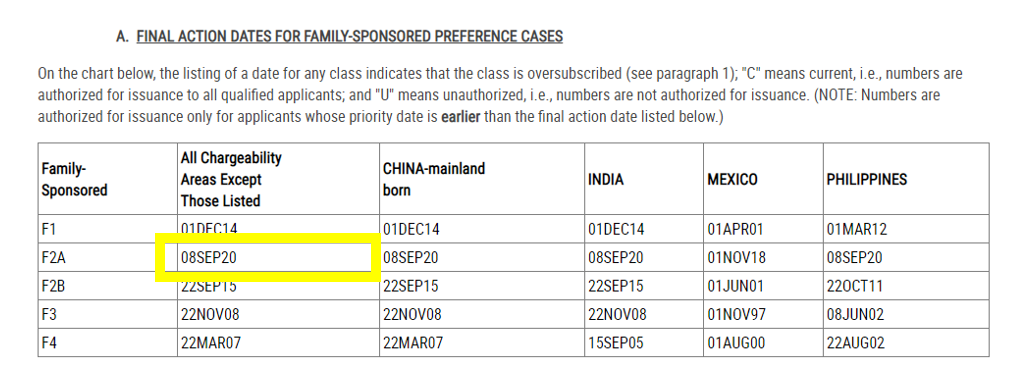
Actuellement, la date d'action finale pour cette classe/catégorie dans la colonne "All Chargeability Areas Except Those Listed" est le 8 septembre 2020. Cela signifie que si la date de priorité indiquée sur votre avis de réception I-130 est postérieure au 8 septembre 2020, les autorités d'immigration ne seront PAS en mesure de vous délivrer un visa d'immigrant ou une carte verte à ce moment-là et vous devrez attendre que la catégorie redevienne d'actualité ou que la date indiquée augmente pour inclure votre date de priorité.


Nous n'avons aucun moyen de prédire quand la date de cette colonne et de cette catégorie redeviendra d'actualité. Le bulletin des visas est mis à jour chaque mois et doit être vérifié tous les mois pour s'assurer que les dates de chaque catégorie de visa sont à jour.


Par conséquent, les demandeurs peuvent continuer à déposer des demandes pour cette catégorie et ces demandes seront acceptées pour traitement, mais un visa ou une carte verte n'est pas immédiatement disponible et ils devront attendre que la date d'action finale devienne actuelle ou inclue leur date de priorité, pour que le visa ou la carte soit délivré(e).

  • Rétrogression EB-2

    EB-2 est la catégorie de préférence fondée sur l'emploi pour les membres de professions libérales titulaires d'un diplôme d'études supérieures ou les personnes présentant des aptitudes exceptionnelles. Cette catégorie de visa (dans cette colonne particulière) est en vigueur depuis des années, mais à partir de novembre 2022, la date d'action finale pour cette catégorie (dans cette colonne) a été reculée et, à partir d'avril 2023, elle l'a été encore davantage.
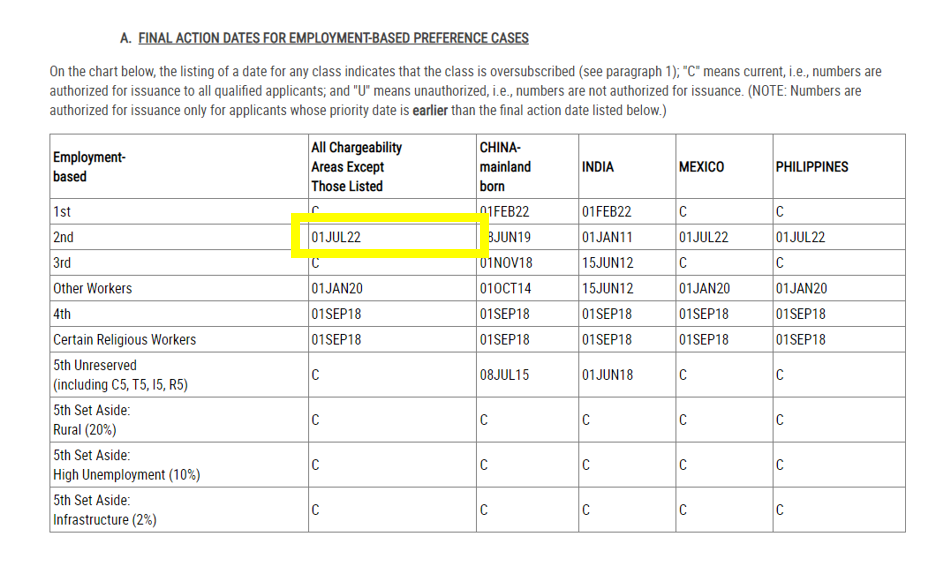
Actuellement, la date d'action finale pour cette classe/catégorie dans la colonne "All Chargeability Areas Except Those Listed" est le 1er juillet 2022. Cela signifie que si la date de priorité indiquée sur votre avis de réception I-140 est postérieure au 1er juillet 2022, les autorités d'immigration ne seront PAS en mesure de vous délivrer un visa d'immigrant ou une carte verte à ce moment-là et vous devrez attendre que la catégorie redevienne d'actualité ou que la date indiquée augmente pour inclure votre date de priorité.


Nous n'avons aucun moyen de prédire quand la date de cette colonne et de cette catégorie redeviendra d'actualité. Le bulletin des visas est mis à jour chaque mois et doit être vérifié tous les mois pour s'assurer que les dates de chaque catégorie de visa sont à jour.


Malheureusement, il y a d'autres mauvaises nouvelles pour cette catégorie....


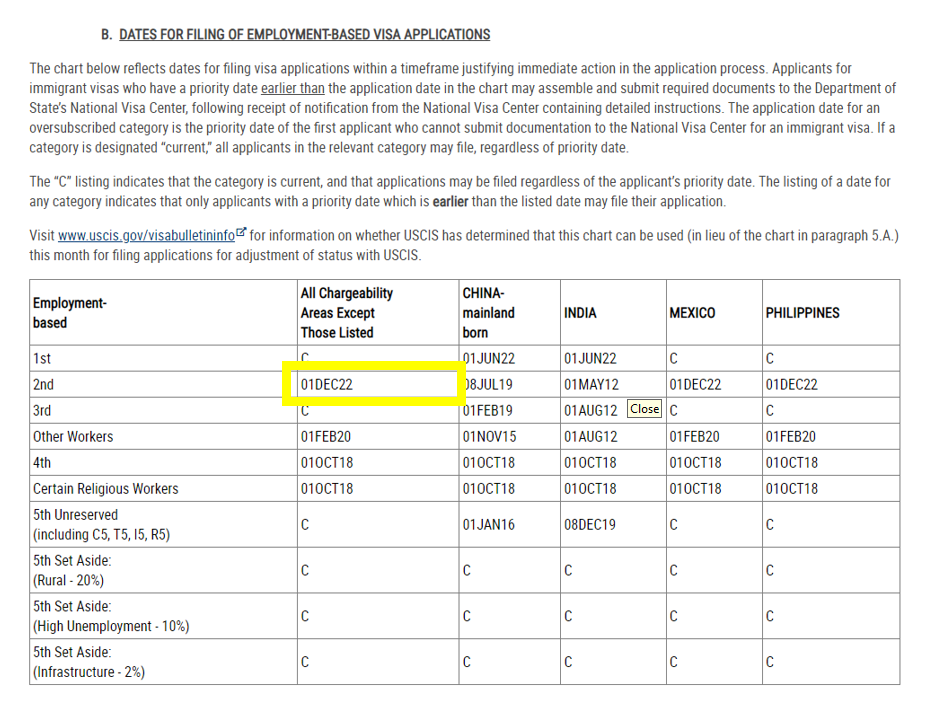
Le tableau des dates de dépôt montre que la date indiquée pour cette colonne et cette catégorie est le 1er décembre 2022. Cela signifie qu'après le 1er décembre 2022, les demandeurs ne pourront même plus déposer de demande I-485 ou soumettre des documents à la CNV en rapport avec leur dossier EB-2, même si la demande I-140 a été approuvée. Tous les demandeurs qui n'ont pas déposé de demande I-485 ou soumis de documents de visa d'immigrant à la NVC avant le 1er décembre 2022 devront attendre que la date de dépôt devienne actuelle ou inclue leur date de priorité, afin de pouvoir déposer ces documents en temps voulu. 
Ce blog n'est pas destiné à fournir des conseils juridiques et rien ici ne doit être interprété comme établissant une relation avocat-client. Veuillez prendre rendez-vous avec un avocat spécialisé en droit de l'immigration avant d'agir sur la base de toute information lue ici.


This Facebook widget is no longer supported.

Angelica Rice

By Juliana LaMendola May 28, 2026
If you have a pending asylum application in the United States, you will now be required to pay an Annual Asylum Fee (AAF) in order to keep your application pending. Understanding this new fee and why it is important could be the difference between maintaining your pending asylum application and facing removal from the country . If your asylum application has been pending for more than one year, you will be required to pay an annual fee of $102 . The good news is that this fee is charged per asylum application, not per person. This means a family applying together on a single Form I-589 will only pay $102 total. However, it is important to know that there are no fee waivers available for this annual payment. It is crucial to take this fee seriously because the consequences for missing your payment are severe . If you receive a notification from USCIS that your fee is due, you will be given exactly 30 days to pay it. If you fail to pay by the deadline, the government may enforce the following penalties: Rejection of your Application: USCIS will reject your pending asylum application. Loss of Work Authorization: Any pending applications for employment authorization (Form I-765) based on your asylum case will be denied. Furthermore, if you already have an approved work permit, you will lose your work authorization immediately. Risk of Deportation: If you do not have an underlying legal status in the U.S., USCIS may initiate your removal (deportation) from the United States. Because of the severe consequences of failure to pay the fee within 30 days, it is vitally important to update your address with USCIS. This ensures you will actually receive the payment notice and can pay it on time without jeopardizing your case. How to Pay: Paying your fee promptly is the best way to protect your asylum status and work authorization. You can easily check if your fee is due and make your payment online by visiting: https://my.uscis.gov/accounts/annual-asylum-fee/start/overview To submit your payment, you will need two important pieces of information:  Your A-Number (Alien Registration Number). The receipt number from your asylum application receipt notice. Once you enter this information, you will see a blue “Pay and submit” button. You can pay securely using a credit card, debit card, or a transfer from a U.S. bank account. Always make sure to save a copy of your receipt to ensure you have evidence of payment. Staying informed and keeping up with the Annual Asylum Fee is an essential part of the asylum process in 2026. Watch your mail for notifications, keep your address updated, and pay your fee as soon as it is due to ensure your case stays on track.
By Josephine Franz May 22, 2026
In the span of about five weeks, U.S. visa policy changed in ways that affect close to 100 countries. A Presidential Proclamation issued on December 16, 2025, expanded an earlier travel ban to cover 39 countries effective January 1, 2026. Two weeks later, the Department of State announced a separate administrative pause on immigrant visa issuance for nationals of 75 countries, effective January 21, 2026. The two policies overlap in places, diverge in others, and together create one of the broadest restrictions on U.S. visa issuance in recent memory. For applicants and employers trying to make sense of the news, the most important point is this: the rules differ depending on (a) which country the applicant is from, (b) which visa category they are seeking, and (c) where they were on January 1, 2026. Below is a practical guide to what is in place, what is still available, and what to do next. Two Distinct Policies, One Confused Headline What the press has often called "the visa freeze" is actually two separate policies, with different legal foundations and different scopes. Presidential Proclamation 10998 the 39-country travel ban. Signed December 16, 2025, and effective January 1, 2026, this proclamation supersedes and expands the June 2025 travel ban. It invokes INA §§ 212(f) and 215(a) the same legal authority that the Supreme Court upheld in Trump v. Hawaii (2018) — and divides affected countries into two tiers. The State Department's 75-country immigrant visa pause. Announced on January 14, 2026, and effective January 21, 2026, this is an internal Department of State policy, not a presidential proclamation. It freezes immigrant visa issuance for nationals of 75 countries on a stated rationale of public charge concerns. It has been challenged in court (CLINIC v. U.S. Department of State, S.D.N.Y., filed February 2, 2026) on grounds including the INA's prohibition on nationality-based discrimination in immigrant visa issuance. Because the policies operate independently, an applicant from a country that appears on both lists faces overlapping restrictions, while an applicant from a country on only one list faces a narrower set. Tier 1: Full Suspension Under Proclamation 10998 (19 Countries) Nationals of these 19 countries are subject to a full suspension of both immigrant and nonimmigrant visa issuance: Afghanistan, Burma, Burkina Faso, Chad, Republic of the Congo, Equatorial Guinea, Eritrea, Haiti, Iran, Laos, Libya, Mali, Niger, Sierra Leone, Somalia, South Sudan, Sudan, Syria, and Yemen. The proclamation also applies to individuals traveling on documents issued or endorsed by the Palestinian Authority. For applicants in this tier, no tourist, student, work, or immigrant visas will generally be issued, subject to a narrow set of exceptions discussed below. Tier 2: Partial Suspension Under Proclamation 10998 (19 Countries + Turkmenistan) Nationals of these 19 countries are subject to a partial suspension: Angola, Antigua and Barbuda, Benin, Burundi, Côte d'Ivoire, Cuba, Dominica, Gabon, The Gambia, Malawi, Mauritania, Nigeria, Senegal, Tanzania, Togo, Tonga, Venezuela, Zambia, and Zimbabwe. For these countries, the proclamation suspends: All immigrant visas, and B-1/B-2 visitor visas, F and M student visas, and J exchange visitor visas. Critically, employment-based and other nonimmigrant categories including H, L, O, P, and R visas remain available to nationals of these countries, although consular officers are directed to reduce the validity period of any such visa to the minimum extent permitted by law. For our firm's many clients in the entertainment, sports, and business immigration space, this distinction is often the difference between a paused career and a viable plan. Turkmenistan occupies a unique position: under the December proclamation, only immigrant visa issuance is suspended; nonimmigrant categories remain available. The Separate State Department Pause (75 Countries) The January 21, 2026 State Department policy paused issuance of immigrant visas only to nationals of 75 countries. The list is broader than the Proclamation 10998 list and notably includes countries with significant client populations for our firm, such as Brazil, Colombia, Egypt, Guatemala, Lebanon, Morocco, Nicaragua, Pakistan, and many others. Two practical points are essential: The pause is limited to immigrant visas. Nonimmigrant visas including B-1/B-2, F-1, J-1, H, L, O, P, and R are not affected by this policy. A Brazilian artist seeking an O-1, a Colombian executive seeking an L-1, or a Lebanese professional seeking an H-1B can generally continue to apply. The policy is being challenged in court. Plaintiffs in CLINIC v. State Department argue that the freeze violates INA § 1152's prohibition on nationality-based discrimination in immigrant visa issuance, the Administrative Procedure Act, and the Fifth Amendment. The outcome is not predictable, and applicants should not delay strategic planning while awaiting a ruling. Who Is Exempt or Otherwise Unaffected Several categories of individuals are not covered by Proclamation 10998, even where their country of nationality appears on the list: Lawful permanent residents of the United States. Green card holders may continue to travel and re-enter, though re-entry can still involve closer secondary inspection. Individuals physically present in the United States on January 1, 2026. The proclamation applies only to those who were outside the U.S. and without a valid visa as of the effective date. Holders of valid visas issued before January 1, 2026. No visa issued before the effective date has been or will be revoked under the proclamation. These visas may continue to be used for travel. Dual nationals who can apply on the passport of a country not subject to the suspension. A, G, and NATO visa holders , certain Special Immigrant Visa applicants, and limited national interest exceptions, including for specific adoption-related cases. It is worth emphasizing that exemption from the entry ban is not the same as exemption from related USCIS processing holds. Some lawful permanent residents from affected countries have nonetheless experienced delays on naturalization (N-400) and family petition (I-130) processing under separate administrative directives. What Applicants Should Do Now Given how rapidly the rules are changing and how case-specific the consequences are, we are advising clients to take the following steps: Identify which list (or lists) applies to you. A national of Iran or Syria faces fundamentally different exposure than a national of Brazil or Colombia, even though both may have heard "visa freeze" in the news. Look at categories, not just countries. For Tier 2 countries and the 75-country pause, employment-based nonimmigrant categories remain a viable path. Many of the O-1, P-1, H-1B, L-1, and EB-1A pathways our firm regularly handles are unaffected by the immigrant-visa freeze. Consider where you are physically located. Applicants currently in the United States have planning options that applicants abroad may not. Departing the country at the wrong moment can convert an inconvenience into a years-long problem. Do not assume current valid visas remain a guarantee of admission. While valid visas are not being revoked, port-of-entry scrutiny has increased, and discretionary admission decisions are ultimately made by Customs and Border Protection. Seek counsel before international travel if you are from any affected country, hold any form of conditional or pending status, or have any concerns about prior immigration history. When to Consult an Attorney The combination of the Proclamation 10998 travel ban, the 75-country immigrant visa pause, ongoing litigation, and the additional USCIS holds on certain benefit applications has produced a landscape where the right answer is rarely obvious from the news alone. Speaking with counsel is especially important when: Your country appears on either list, and you have a pending or planned visa application. You are weighing whether to leave the United States for a consular interview. You are an employer with a foreign national workforce and need to understand which categories remain viable. You are a dual national considering which passport to use. You hold a valid visa from before January 1, 2026, and are uncertain whether to travel. At Santos Lloyd Law Firm, we represent clients from across the affected country lists including substantial numbers in entertainment, sports, business, and family immigration and we are actively monitoring both the litigation and the State Department's evolving guidance. If you have questions about how the current restrictions apply to your case or your company, our attorneys are available to help you build a plan.
By Kris Quadros-Ragar May 14, 2026
Holding a U.S. visa does not guarantee permanent entry. The Department of State can cancel a visa after it is issued through a process called “prudential visa revocation.” These revocations have surged throughout 2025 and 2026. This increase is a direct result of enhanced vetting and increased data sharing between government agencies. Through the Continuous Vetting Center, law enforcement and immigration databases are now cross-referenced in real time, allowing officials to flag and revoke visas the moment new information surfaces or updated information is received, such as a past criminal arrest or a security alert. What is Prudential Visa Revocation? A prudential revocation is a precautionary cancellation. It happens when new information suggests a traveler might be ineligible for a visa or could pose a safety concern. A revocation cancels your visa, but it does not automatically end your status if you are already inside the U.S. and following the rules of your stay. Common triggers include: Criminal Arrests (DUI/DWI): Even a previous incident or single arrest without a conviction can trigger an immediate revocation. Security Alerts: New hits on watchlists or intelligence databases. Loss of Eligibility: Such as losing a job or failing to maintain student status. Fraud: Discovery of errors or lies on previous applications. The DOS usually notifies individuals via the email address listed on their DS-160 application. However, many travelers reportedly only discover the revocation when they are denied boarding at the airport. If your visa is revoked while you are in the U.S., you can typically remain in the country until the date on your Form I-94 expires, provided you continue to follow all terms of your stay. However, you should avoid international travel until you consult with legal counsel, as leaving the U.S. will require you to apply for a brand-new visa to re-enter. This application process may involve extra scrutiny, such as medical evaluations or supplemental documentation - especially if the revocation was triggered by a DUI or DWI. If your visa has been revoked and you need to discuss your legal options, please contact Santos Lloyd Law Firm for guidance.
Show More